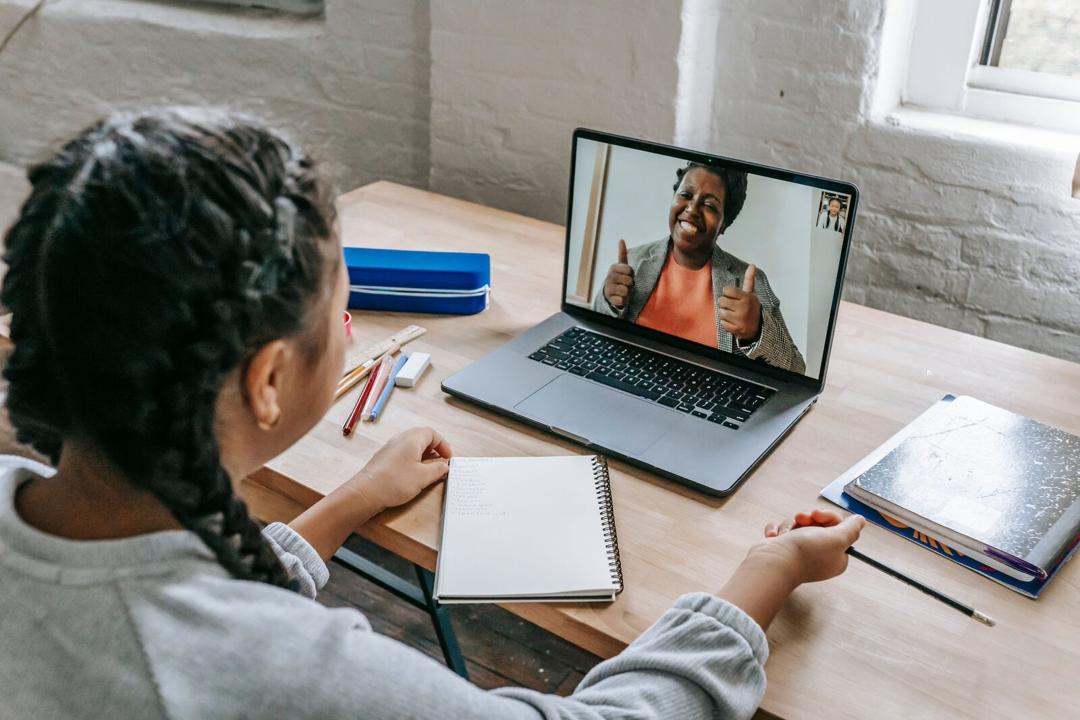
Have you hesitated to try online tutoring for your dyslexic or struggling reader? Many parents dismiss it as a last-ditch option.
"In-person is best" has long been the motto for the type of intensive, one-to-one tutoring that leads to measurable gains in reading and spelling. I've said it myself.
But new research is challenging that assumption.
What the research actually found
Two recent studies from Johns Hopkins University's Center for Research and Reform in Education indicate that online tutoring, taught well, is nearly as effective as in-person instruction.
The first followed roughly 1,900 first graders across 13 Massachusetts districts receiving one-to-one virtual tutoring. It found an effect size of .21 — very close to the .24 typically reported for in-person tutoring. Attendance topped 85 percent, which anyone who has scheduled tutoring around a family's week will recognize as remarkable.
The second, a randomized trial in a rural Texas district, found that first graders tutored four times a week for a semester gained nearly 1.6 additional months of learning. Students who attended at least 40 sessions gained more. A follow-up study across a full school year more than doubled those gains.
The lesson isn't that screens are magic. It's that consistency and quality matter more than instructional format. High-dosage, evidence-based, structured one-to-one tutoring produces the strongest results, both in person and online.
Given a good program and a capable tutor, online lessons can be a viable option for busy families, parents on a tight budget — even for private schools and entire school districts.
Why? Four reasons.
1. Online instruction is much improved
New science of reading programs such as those offered by NOW! Foundation, Kids Up, and Lexercise are online-based, and many well-established programs such as Wilson and Barton have added online components.
For tutors, platforms such as Koala Go, Classin, and LearnCube give choices besides Zoom and Google Slides, and help keep lessons moving by enabling tutors to switch quickly between screens. Sites such as WordWall let tutors easily make video-game style activities that they can customize for individual students. A quick AI prompt can produce a tailored word list or reading passage in seconds.
In some ways online teaching allows for more flexibility than a table and a stack of cards.
2. Students are already used to it
After the whirlwind of COVID, virtual lessons did not disappear, and students have adapted. Some prefer online learning. Others have grown comfortable with it. Online classes have become a routine aspect of our screen-obsessed culture.
In virtual sessions students can do much of what they do in person: manipulate tiles for spelling, read words and phrases and sentences and paragraphs, write on paper and on screen, read flash cards. But they can also do video-game style activities, watch quick videos, and see photos. Tutors can keep students engaged with seamless transitions between activities. There is less time wasted.
3. Nobody has to drive
Tutoring involves traveling. In the stone-age '90s one parent drove 100 miles round trip twice a week so I could tutor her son. That's extreme, but fighting traffic to get back and forth to tutoring is no one's idea of fun.
Nor is it fun for tutors to fight traffic to get to students. Online learning allows both tutors and students to get comfortable in familiar surroundings before switching on their screens, frees time for parents, and reduces traffic-related stress.
4. It costs less
Largely because there are no travel costs, an online tutoring session is typically $10 to $30 less than an in-person lesson. And as technology improves online efficiency, lessons can often be shorter but just as effective — maybe 20 minutes instead of 30, 45 minutes instead of an hour.
Saving time and money with the assurance that online tutoring is effective provides peace of mind and simplifies scheduling.
If your student is ready.
The honest drawbacks
Writing is a big one. Students either write on paper and hold it up to the camera, take a picture of what they write and send it to the tutor through the meeting platform, tell the tutor what they wrote, or type their answers. None are ideal, but pencil on paper is preferred, and most students are fine holding their writing up for the camera or sending a photo.
Another drawback is personal connection. While you do form a bond with students online, it's not as strong as it would be in person. Knowing each other well is more difficult, and subtle body language clues can go unnoticed.
Most importantly, if the student isn't ready for online tutoring it just won't work. It requires attention, a familiarity with technology, and a degree of maturity. Students with severe ADD or ADHD might find it too overwhelming. The youngest learners are better served in person before transitioning to online.
So is your student ready?
For parents whose kids can handle it, virtual tutoring is a valid option. In the hands of a capable instructor it won't compromise your child's reading progress.
Lessons are cheaper, which is quantifiable. The stress and time saved by not having to drive? Priceless.
Linguistics Edge offers discounted prices for online lessons, as well as hybrid plans that mix in-person and online sessions. There are further discounts for multiple weekly lessons and for siblings.
There are a few current openings for fall, in person and online.